
The Renton City Council is scheduled to convene for a crucial vote on a proposed municipal ordinance that would prohibit camping on public property throughout the city. If enacted, the legislation will position Renton alongside a growing list of Washington State municipalities that have established stricter regulations on public spaces and unauthorized encampments.
The local legislative push comes in the wake of a major U.S. Supreme Court ruling, which established that municipal camping bans do not constitute "cruel and unusual punishment" under the Eighth Amendment of the Constitution. That landmark legal decision removed significant constitutional constraints, granting local governments broad legal discretion to clear public encampments and regulate how public lands are utilized.
Following the federal ruling, several other cities across the Puget Sound region moved quickly to update their local municipal codes. Communities such as Lakewood, Tukwila, and Burien have already implemented similar prohibitions, creating a regional trend toward tighter public space management that Renton lawmakers are now considering joining.
Under the provisions of Renton’s proposed ordinance, individuals will be strictly forbidden from establishing campsites, erecting tents, or hanging tarps on any municipal property. The broad prohibition applies to a wide range of public areas, specifically targeting city-managed parks, pedestrian trails, municipal parking facilities, and other public grounds throughout Renton.
In addition to prohibiting tents and temporary structures, the draft measure places strict limitations on everyday survival activities and personal storage in public spaces. The proposed law makes it an offense to light open fires, store personal property, or stash shopping carts anywhere on municipal land, substantially altering the presence of unhoused individuals in public spaces.
To facilitate enforcement, the city's measure outlines the establishment of designated trespassing zones on city-owned land. These regulatory zones are designed to give local officials and law enforcement authorities the legal standing to intervene, issue notices, and clear unauthorized camps and accumulated personal property from public real estate.
The ordinance also establishes formal penalties for those who do not comply with municipal directives. While initial encounters are aimed at clearing spaces, repeat violators could face misdemeanor criminal charges. Under Washington misdemeanor statutes, convictions can result in punitive measures of up to 90 days in jail, a fine of up to $1,000, or a combination of both.
Despite the strict penalty framework outlined in the draft legislation, the proposed ordinance specifies that municipal representatives must offer outreach and social services to unhoused individuals before enacting punitive enforcement. City leaders have indicated that providing access to supportive resources is meant to serve as a vital component of the policy.
The effort to merge legal enforcement with social assistance has garnered support from community advocates working directly with vulnerable populations. Max Komar, a representative from the non-profit organization Battlefield Addiction, stated that maintaining public accountability while offering compassionate care is an attainable and necessary approach for local governments.
Battlefield Addiction frequently conducts outreach among individuals struggling with severe substance abuse disorders, including many who reside in unsanctioned homeless camps. Komar noted that while these individuals urgently require assistance and recovery support, local residents and families also deserve safe, accessible neighborhoods. He expressed support for reasonable policies that curtail public drug use and unregulated camping while systematically connecting unhoused residents with rehabilitation and social resources.
However, the proposed restrictions present severe challenges for individuals who currently have nowhere else to live. For unhoused residents across Renton, the implementation of a sweeping ban leaves few options for shelter and daily survival. Among those feeling the direct impact of the looming policy is Nicole, a local woman who has experienced homelessness for roughly three to four years.
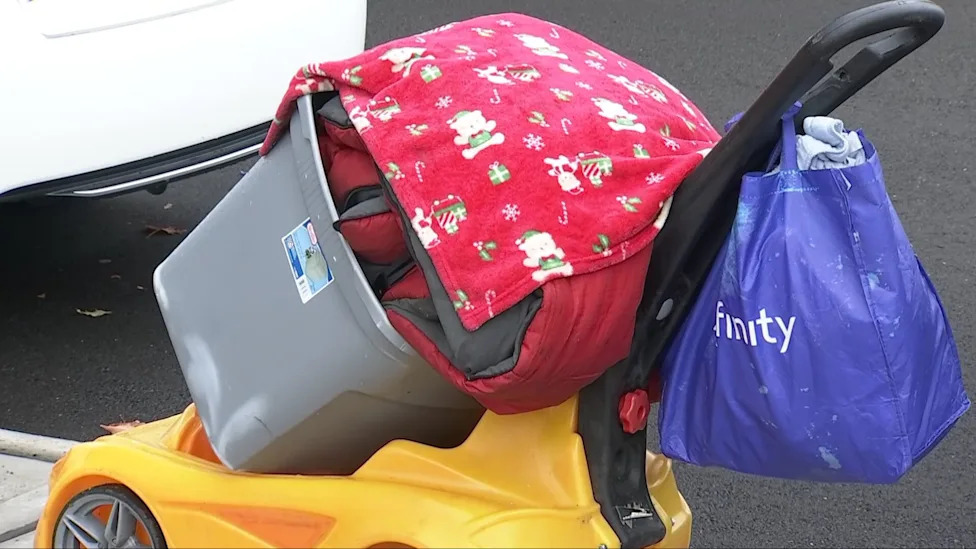
Speaking on the street in downtown Renton while transporting her few remaining belongings in a child’s push car, Nicole shared the personal devastation of losing everything she once owned. She explained that she relies on paved municipal areas and parking lots to sleep overnight, finding them preferable to available shelter options.
Nicole voiced strong resistance to entering emergency shelters, explaining that she views institutional shelter environments with deep distrust. Characterizing shelters as unhealthy and unsafe, Nicole stated firmly that she would rather face the elements and live on the streets than enter an indoor shelter facility.
For unhoused people who share Nicole's distrust of group shelters, the proposed ban on parking lots, trails, and parks poses a profound dilemma. Because the ordinance outlaws the basic means of sheltering oneself outdoors and carrying essential belongings in carts, displaced residents will find their survival options increasingly constrained within city boundaries.
As the Renton City Council prepares to cast its vote, the city stands at a pivotal crossroads between public order and human services. The outcome of Monday’s decision will determine how Renton addresses unauthorized encampments, tests the balance between accountability and support, and shapes the future of its most vulnerable residents.


(0)