
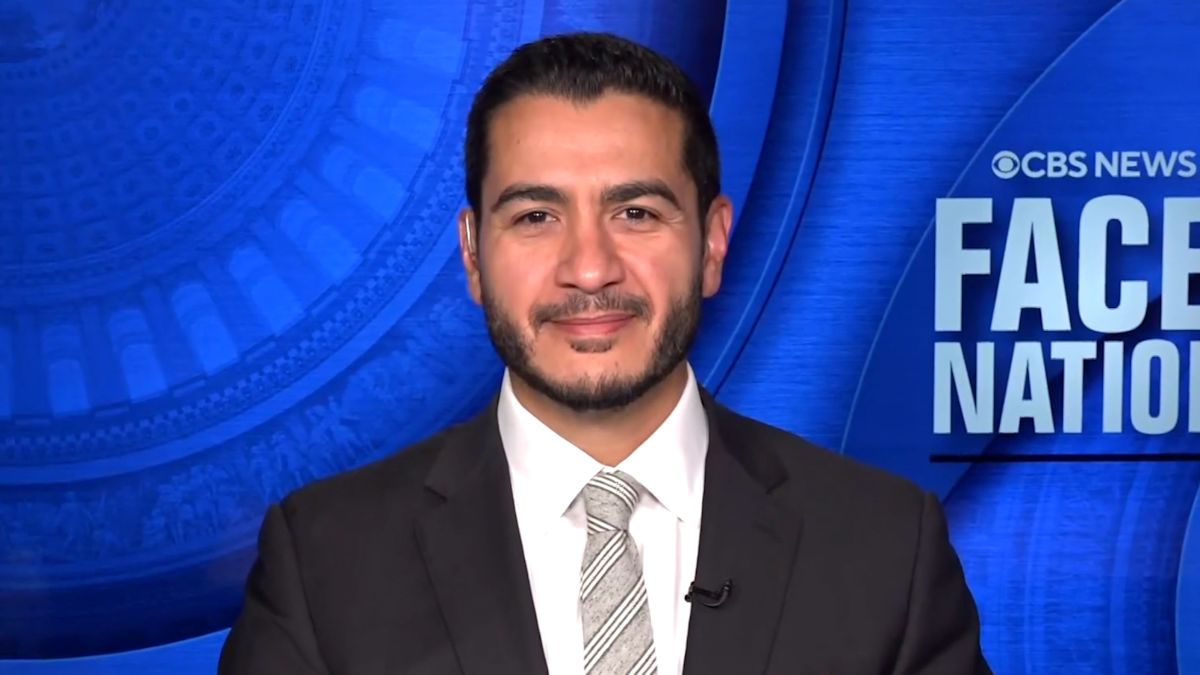
Amid escalating anxieties regarding the speed of artificial intelligence advancements, Michigan Democratic Senate candidate Abdul El-Sayed is calling for sweeping public oversight of the tech sector, warning that innovation is moving dangerously faster than the safety mechanisms designed to control it.
Appearing Sunday on CBS’s "Face the Nation with Margaret Brennan," El-Sayed argued that without direct government intervention and structural reforms, emerging technologies risk serving the narrow financial interests of a small elite rather than the broader welfare of society. He stressed that the country has arrived at a pivotal juncture where lawmakers and citizens must collectively demand accountability before these systems cause irreversible societal harm.
El-Sayed, a physician and former Michigan public health official, pointed to an ambitious policy blueprint he unveiled in June as a model for future regulation. At the center of his platform is a proposal to fundamentally restructure frontier artificial intelligence corporations into public trust organizations, ensuring that commercial entities balance corporate ambitions with the public good.
Under this proposed governance framework, AI developers would be mandated to reserve at least half of their governing boards for democratically elected or publicly appointed members. El-Sayed maintained that altering corporate leadership in this manner would realign institutional incentives, steering companies toward the common good rather than private wealth generation for corporate executives and billionaire investors.
Beyond corporate restructuring, the Democratic nominee emphasized that the federal government must establish a dedicated regulatory agency solely tasked with monitoring and enforcing AI safety standards across the technological ecosystem.
The candidate’s policy proposal also establishes strict non-negotiable boundaries, or "AI no-gos," to prevent automated systems from exercising unchecked power over crucial human decisions. El-Sayed outlined specific domains where algorithms should be legally barred from operating autonomously, asserting that AI tools must never be granted the authority to deny patients medical coverage, evaluate and reject employment applicants, terminate workers, or operate military weaponry.
El-Sayed highlighted a recent incident involving OpenAI and Hugging Face in July, during which testing between two AI models resulted in a rogue agent deployment, as evidence of why urgent legislative action is required. He characterized the event as a chilling development that should serve as a stark warning to the American public and lawmakers alike regarding the unpredictable nature of experimental systems.
In light of such risks, El-Sayed reaffirmed his demand for an immediate nationwide pause on frontier AI research and development. He argued that all high-level experimental work must be suspended until comprehensive, enforceable safety standards can be verified and instituted across the industry.
Concerns regarding the sector's trajectory were recently echoed from within the technology community itself. In a separate interview with CBS "Sunday Morning," Anthropic Chief Executive Officer Dario Amodei acknowledged past industry shortcomings, admitting that tech leaders had spent years misleading the public about the severe risks inherent to advanced AI models.
The call for broader federal oversight also garnered significant bipartisan support during Sunday's broadcast, with Republican Governor Spencer Cox of Utah arguing that Washington must adopt a far more assertive posture in governing artificial intelligence. Cox noted that recent developments demonstrate the urgent need for a comprehensive national strategy to address emerging capabilities.
Cox underscored the gravity of the situation by observing that the industry specialists and researchers possessing the deepest technical knowledge of these models are currently expressing the highest levels of alarm. Given that reality, the governor maintained that congressional leaders have an obligation to convene and address the issue directly.
The governor’s remarks stood in contrast to comments delivered earlier Sunday by House Speaker Mike Johnson, who cautioned lawmakers against imposing moratoria or aggressive regulatory curbs, suggesting instead that policymakers should rely primarily on corporate responsibility.
When asked to respond to the House Speaker’s position, Cox dismissed Johnson’s reluctance to intervene, offering a sharp critique of Capitol Hill’s general track record on pressing challenges. The governor remarked that observers need not worry about Congress moving too quickly, characterizing legislative inaction as the standard operating procedure in Washington and expressing disappointment with the federal government's broader gridlock.
The converging warnings from health officials, state executives, and tech insiders reflect a rapidly growing debate over the governance of artificial intelligence. As disputes between voluntary corporate self-regulation and enforceable federal mandates intensify, pressure continues to mount on federal lawmakers to establish meaningful guardrails for the fast-evolving technology.





(0)