
Across Oklahoma, a growing number of church leaders are raising their voices against what they view as a troubling misuse of religious faith by political candidates seeking to influence voters during election season. In response to a barrage of campaign literature and political advertisements cloaked in religious rhetoric, several prominent ministers across the state are organizing specialized sermon series designed to help their congregations distinguish between genuine spiritual devotion and partisan manipulation.
The pushback from local clergy comes amid an influx of political materials flooding residential mailboxes across the state. Thousands of households have received campaign flyers featuring candidates boldly proclaiming their Christian beliefs and asserting that supporting their candidacies equates to standing up for Christian values. At the same time, television commercials have frequently depicted political hopefuls strolling through church buildings, visually linking their political ambitions to the Christian faith.
For multiple pastors across Oklahoma communities, this growing trend has become a significant source of pastoral concern. Rather than seeing these displays as authentic expressions of personal piety, faith leaders are alarmed by the way sacred principles, vocabulary, and symbols are being harnessed to drive partisan division, appeal to voters, and score political victories.
Among the most outspoken voices addressing this issue is the Rev. Mark Foster, who serves as the senior pastor of Acts 2 United Methodist Church in Edmond. Foster has openly questioned the messaging frequently found on election mailers, particularly the common assertion that voting for a specific politician represents an endorsement of Christian values. He pointed out that such campaign rhetoric rarely explains what those values truly entail in practical, biblical terms.
Foster emphasized that from a scriptural standpoint, authentic Christian values are defined by clear commands to show compassion and mercy. He highlighted core biblical responsibilities such as feeding the hungry, extending hospitality to the stranger, caring for the immigrant, and actively supporting one's neighbor. In Foster's view, political discourse frequently ignores these essential duties in favor of selective, self-serving interpretations.
The Edmond pastor noted that when candidates invoke Christian values in political materials, they often cherry-pick convenient elements while completely bypassing foundational spiritual teachings. In particular, Foster observed that political platforms and slogans rarely reflect the Beatitudes, the central teachings on humility, mercy, and peacemaking delivered by Jesus Christ in the fifth chapter of the Gospel of Matthew.
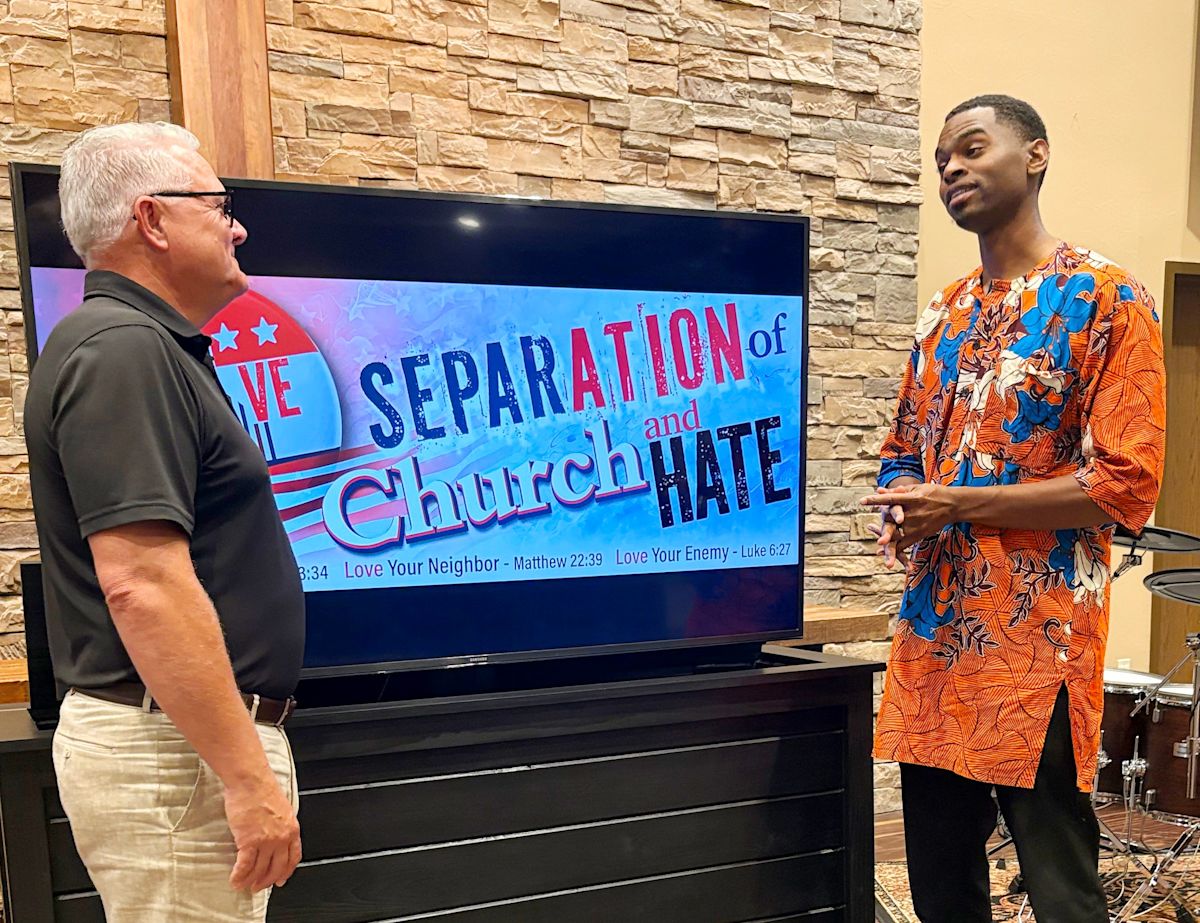
To address these concerns directly with his congregation, Foster launched a multi-week teaching series titled "Separation of Church and Hate." The primary objective of the program is to equip parishioners with the spiritual discernment needed to differentiate between candidates who genuinely embody Christian principles and those who merely exploit religious terminology to secure electoral support.
Foster underscored the critical timing of the initiative during the series' debut on Sept. 6. Addressing church members, he delivered a pointed warning regarding the upcoming nine weeks of campaigning, stating that it is both wrong and dangerous for politicians to take the transformative message of Christ’s love and distort it to merge Jesus with meanness and hostility.
As part of the initiative at Acts 2 United Methodist Church, Foster has also welcomed guest speakers to the pulpit to address these complex cultural issues. Among them is speaker Julian Davis Reid, who joined Foster in Edmond to deliver a message aligned with the church’s effort to reject partisan vitriol and refocus on spiritual integrity.
The educational effort in Edmond is part of a broader movement among Oklahoma congregations striving to confront growing societal polarization, hateful rhetoric, and ideologies such as Christian nationalism. Local faith leaders are increasingly stepping forward to remind their members that the Christian message should not be co-opted as an instrument for political dominance or cultural warfare.
Another congregation actively addressing these dynamics is New Covenant Christian Church (Disciples of Christ). The church's senior minister, the Rev. David Wheeler, is introducing his own targeted preaching series to encourage thoughtful, faith-informed civic engagement that transcends partisan talking points.
Wheeler's sermon series, titled "Faith Was Never Supposed to be Silent: Justice is What Faith Sounds Like in Public," begins on Sunday, Sept. 13. The series aims to challenge believers to think deeply about how their spiritual convictions translate into public life, emphasizing that genuine faith is demonstrated through the pursuit of justice, fairness, and care for the broader community.
By launching these concurrent sermon series, pastors like Foster and Wheeler are seeking to provide an alternative narrative in a state where political rhetoric often relies heavily on religious identity. Rather than allowing political campaigns to define the parameters of faith, these ministers are urging churchgoers to hold political claims up to the light of foundational biblical mandates.
As the campaign season progresses across Oklahoma, these pastoral efforts represent an active stand by local churches to reclaim the core tenets of their traditions. Through dedicated preaching, thoughtful dialogue, and scriptural reflection, faith leaders are working to ensure that their congregations remain grounded in love, justice, and compassion rather than being swayed by partisan agendas.




(0)